SEO for Sharetribe Marketplaces
Marketplace SEO is different from normal website SEO because the most valuable pages are often dynamic, inventory-based, location-based, and category-driven.
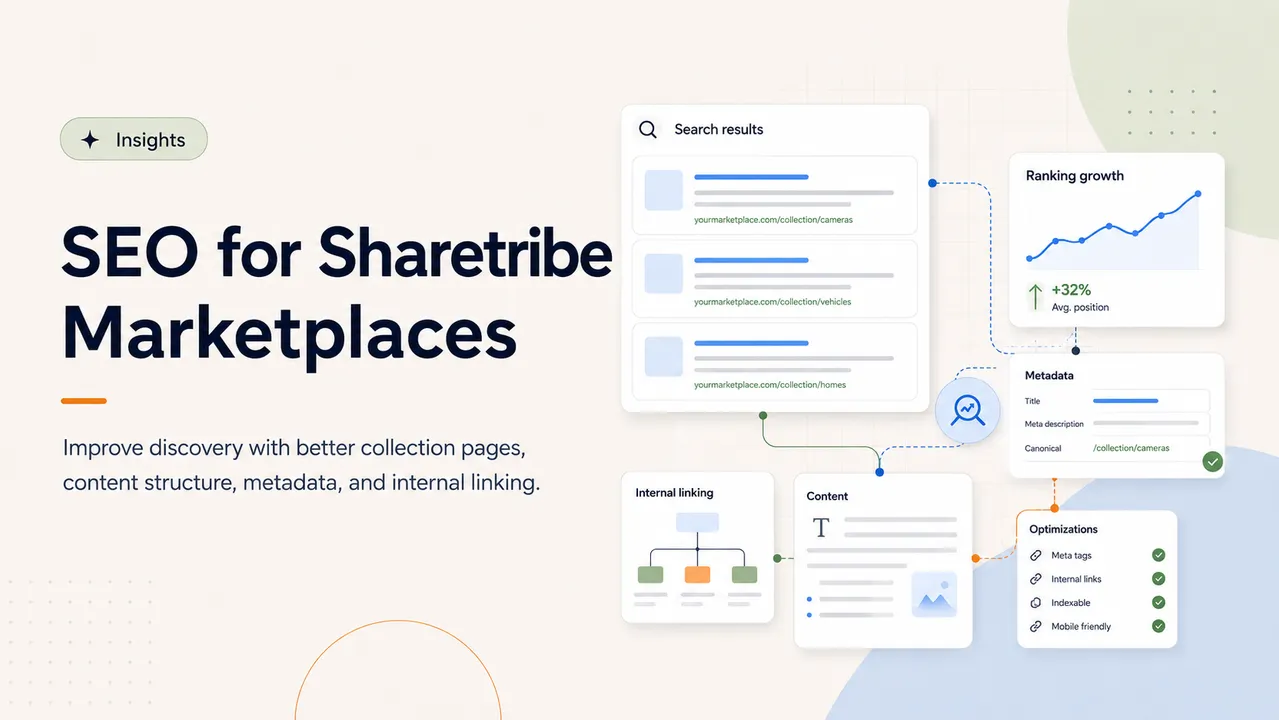
Why marketplace SEO is different
A marketplace has many page types: landing pages, category pages, collection pages, listing detail pages, seller profiles, guides, and blog posts. Each page type has a different search role.
The challenge is to create indexable pages that match search intent without creating thin, duplicated, or low-quality pages at scale.
Collection and category pages
Collection pages are often the best SEO opportunity. They can target searches like category plus location, service plus audience, product type plus use case, or niche marketplace terms.
These pages need more than a listing grid. Add helpful copy, FAQs, filters, internal links, and clear metadata so search engines and users understand the page.
Listing page metadata
Listing pages should have unique titles and descriptions based on listing attributes such as name, category, location, price, availability, and seller context.
Avoid generic metadata across every listing. If search results all look the same, users have little reason to click and search engines have little reason to rank them.
Canonicals and duplicate content
Marketplace filters can create many URL combinations. Some should be indexable, but many should not. Canonical rules help prevent duplicate content and ranking dilution.
Decide which pages deserve organic traffic and which pages are only functional filters. This decision should be reflected in canonical tags, sitemap inclusion, and internal linking.
Internal linking
Internal links help users and search engines discover important marketplace pages. Link from landing pages to categories, from categories to popular filters, from listings to related collections, and from blog guides to relevant marketplace pages.
Do not rely only on navigation. Contextual links inside content often carry stronger intent and improve user flow.
Content pages and guides
Blogs, guides, comparison pages, and educational pages can target earlier-stage searches before users are ready to transact.
For Sharetribe marketplaces, a CMS like Strapi can help manage content pages that link into marketplace inventory and support long-term SEO growth.
Technical performance
SEO also depends on performance, mobile usability, structured data, image optimization, sitemap health, crawlability, and Google Search Console monitoring.
A fast marketplace with clear metadata, useful content, and indexable collection pages has a much better chance of compounding organic traffic.
Key takeaway
Marketplace SEO is a system. Improve page structure, metadata, content, internal links, indexation rules, and performance together instead of treating SEO as a one-time title tag task.
Related articles
Keep reading

AI + Sharetribe: Practical Automation for Marketplaces
Use AI to improve discovery, support, moderation, and operations in real marketplace workflows.

Sharetribe Mobile Template: What to Build First
A practical roadmap for launching a mobile marketplace with the right flows, screens, and priorities.
Sharetribe Marketplace Development Guide
Core architecture, listing flows, transactions, and extensions for building a scalable marketplace.
Work With DevsCrew
Building a marketplace or AI product?
We help founders and teams design, build, and scale Sharetribe marketplaces, AI features, mobile apps, and complex product workflows.