Sharetribe Marketplace Development Guide
Sharetribe gives marketplace teams a strong foundation, but successful platforms still need product decisions around listings, transactions, roles, content, payments, and operations.
What Sharetribe gives you
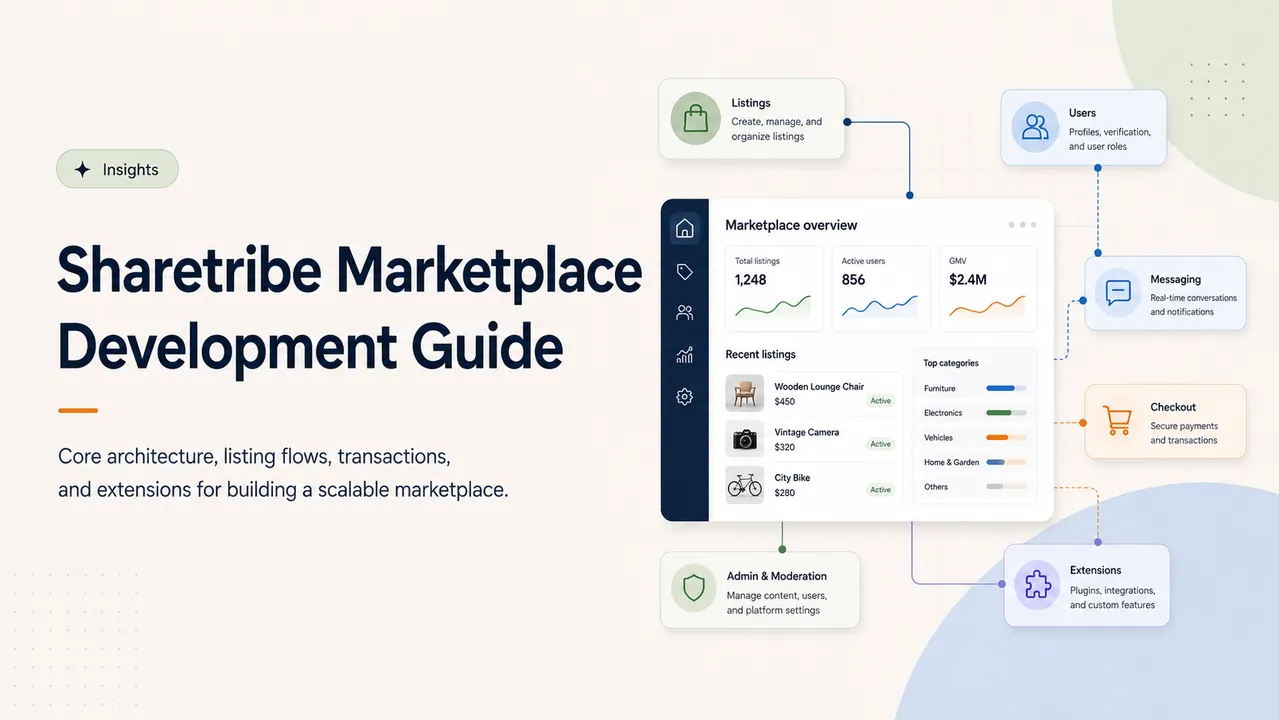
Sharetribe provides marketplace building blocks such as users, listings, search, messaging, transactions, reviews, availability, and payment integration patterns. This lets teams move faster than building every marketplace primitive from scratch.
The platform is strongest when your marketplace concept fits a defined transaction model and you use custom development to shape the user experience, integrations, and operational logic around your business.
Where custom development starts
Custom development usually starts where the marketplace needs a specific user journey. This can include custom landing pages, listing fields, filters, booking flows, offer flows, dashboards, mobile apps, or admin workflows.
The important question is not whether Sharetribe can support the marketplace. The question is which parts should be configured, which parts should be customized, and which parts should be handled by external services.
Listing and search structure
Listings are the core content unit of a marketplace. Fields, categories, locations, availability, pricing, media, and seller details all influence conversion and search quality.
A scalable listing model should be simple enough for sellers to complete and structured enough for buyers to filter. The more niche the marketplace, the more important custom attributes become.
- Categories and subcategories
- Search filters and sorting
- Location and map data
- Pricing, availability, and listing rules
Transaction processes
A transaction process controls the business workflow: inquiry, booking, purchase, payment, delivery, completion, cancellation, refund, and payout timing.
This is where many marketplace builds become more complex than a normal website. The transaction flow must match how the business actually operates and what users expect at each state.
User roles and permissions
Most marketplaces have at least buyers and sellers. Many also need providers, hosts, admins, moderators, affiliates, teams, or verified users.
Roles affect onboarding, profiles, dashboards, listing permissions, messaging, payment setup, content visibility, and analytics. Define them early because role decisions influence almost every product surface.
Admin and operational logic
Marketplace growth depends on operations. Admins need visibility into users, listings, transactions, disputes, content, payouts, and performance.
A useful marketplace build often includes custom admin tools, alerts, dashboards, CMS pages, moderation queues, and automation that reduces manual work as transaction volume grows.
When to use external services
External services can support areas such as payments, shipping, identity verification, maps, analytics, email, CMS content, CRM, marketing automation, and AI workflows.
The best integrations are chosen for a specific operational reason. Add services when they improve trust, conversion, compliance, content control, or team efficiency.
Key takeaway
Sharetribe accelerates marketplace development, but the product still needs thoughtful architecture. Invest early in listing structure, transaction logic, user roles, admin workflows, and integrations.
Related articles
Keep reading

AI + Sharetribe: Practical Automation for Marketplaces
Use AI to improve discovery, support, moderation, and operations in real marketplace workflows.

Sharetribe Mobile Template: What to Build First
A practical roadmap for launching a mobile marketplace with the right flows, screens, and priorities.
Custom Transaction Processes in Sharetribe
How tailored workflows can support bookings, offers, shipping, payouts, and edge cases.
Work With DevsCrew
Building a marketplace or AI product?
We help founders and teams design, build, and scale Sharetribe marketplaces, AI features, mobile apps, and complex product workflows.