Scaling a Marketplace with Web, Mobile, Admin & Automation
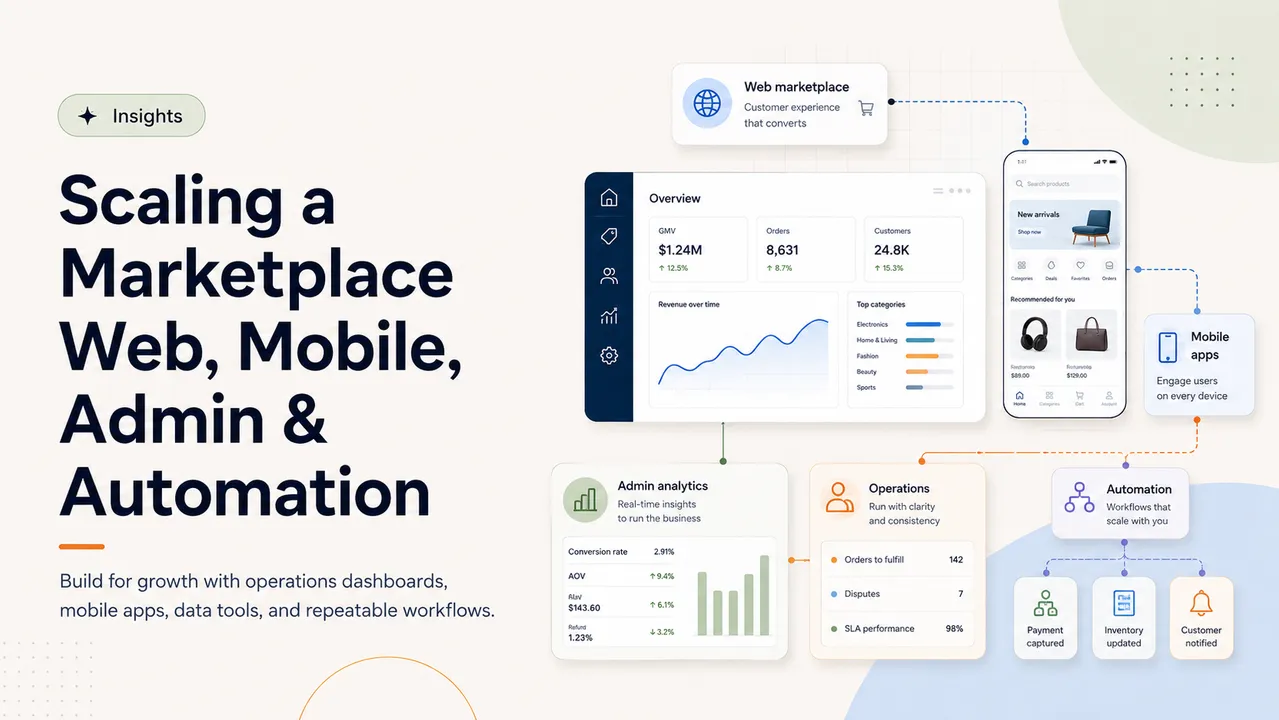
Scaling a marketplace means making the platform easier to operate as users, listings, transactions, content, and support volume increase.
What scaling actually means
Scaling is not only more traffic. It is more edge cases, more support questions, more listing quality issues, more payment events, more seller needs, and more operational decisions.
A marketplace that scales well gives the team visibility and repeatable workflows instead of forcing every issue into manual support.
Admin dashboards
Admin dashboards should surface the work that matters: pending transactions, failed payments, flagged listings, disputes, seller onboarding issues, content updates, and key performance metrics.
The best dashboards are action-oriented. They do not just show data; they help admins decide what to do next.
Mobile apps
Mobile apps can increase repeat engagement, speed up messaging, improve notifications, and make marketplace participation easier for buyers and sellers.
The mobile experience should focus on high-frequency actions first, such as browsing, messaging, saved listings, booking updates, checkout, and notifications.
Analytics and reporting
Marketplace teams need to understand acquisition, activation, conversion, supply quality, search behavior, message response time, cancellation reasons, and repeat usage.
Analytics should connect product decisions to business outcomes. It should help the team improve onboarding, search, pricing, supply, trust, and retention.
Automations and notifications
Automation can reduce manual work by sending reminders, routing support issues, updating inventory, syncing CRM data, notifying admins, or generating operational summaries.
Notifications should be useful, not noisy. Each notification should help a user complete an action or help an admin prevent a problem.
Operational workflows
As the marketplace grows, teams need clear workflows for verification, moderation, refunds, disputes, content management, seller support, and transaction exceptions.
Documented workflows make the marketplace easier to run and easier to improve. They also make automation safer because the system has clear rules to follow.
Support and maintenance
Marketplace maintenance includes dependency updates, provider changes, payment testing, API monitoring, QA, SEO checks, performance improvements, and user feedback review.
Long-term growth depends on keeping the platform reliable while improving the parts of the experience that limit conversion or operations.
Key takeaway
Scaling a marketplace requires product, engineering, operations, and support systems to work together. Web, mobile, admin dashboards, analytics, and automation should all support the same marketplace workflow.
Related articles
Keep reading

AI + Sharetribe: Practical Automation for Marketplaces
Use AI to improve discovery, support, moderation, and operations in real marketplace workflows.

Sharetribe Mobile Template: What to Build First
A practical roadmap for launching a mobile marketplace with the right flows, screens, and priorities.
Sharetribe Marketplace Development Guide
Core architecture, listing flows, transactions, and extensions for building a scalable marketplace.
Work With DevsCrew
Building a marketplace or AI product?
We help founders and teams design, build, and scale Sharetribe marketplaces, AI features, mobile apps, and complex product workflows.