Payment Integrations in Sharetribe
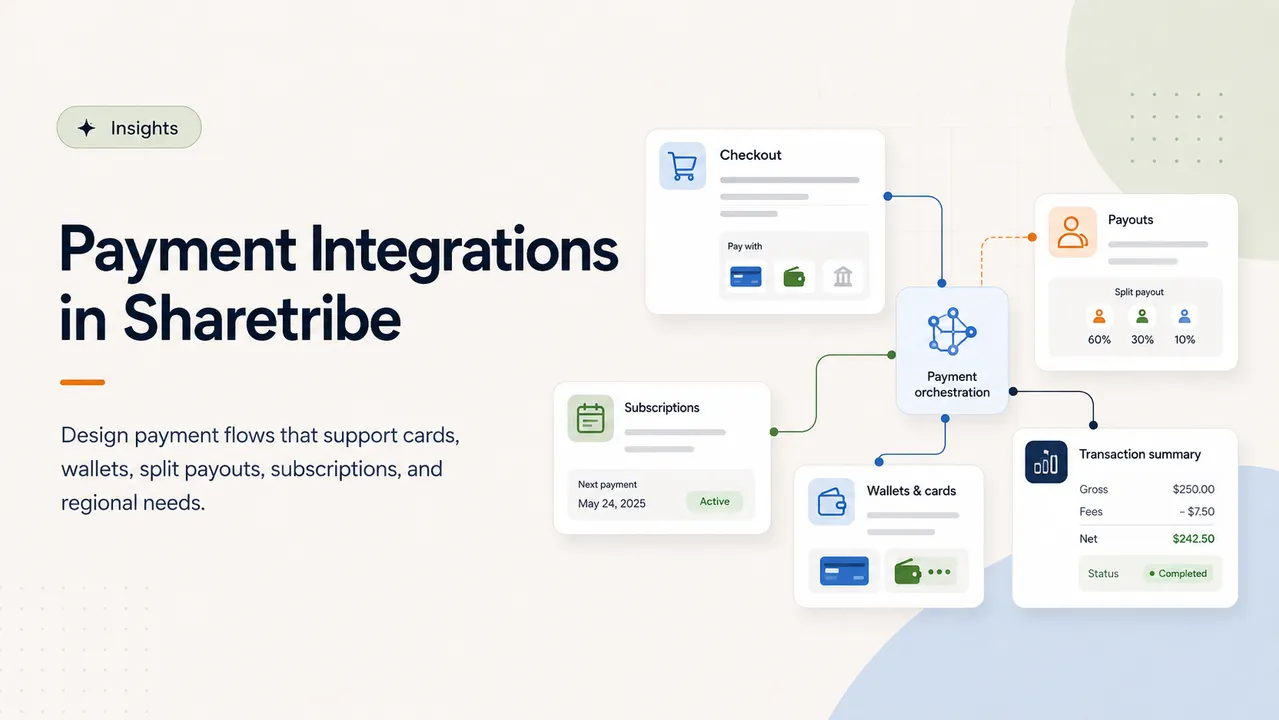
Payment integration is not only about taking money. In a marketplace, payments shape seller onboarding, transaction states, platform fees, refunds, payout timing, and user trust.
Start with the business model
Before choosing a payment provider, define the business model. Are users buying products, booking services, renting assets, subscribing, sending offers, or paying invoices?
Each model creates different requirements for authorization, capture, payout timing, cancellation rules, taxes, receipts, and platform commissions.
Stripe and Stripe Connect
Stripe Connect is a common marketplace payment foundation because it supports seller onboarding, platform fees, split payouts, and compliance flows.
The implementation still needs careful UX. Sellers need to understand onboarding status, payout requirements, verification issues, and why a payout may be delayed.
PayPal and alternate payment methods
Some marketplaces need PayPal, wallets, bank payments, or other local payment methods because buyers trust them or expect them in a region.
Alternate payment methods can improve conversion, but they also add transaction-state complexity. Confirm how refunds, disputes, fees, and payout timing work before adding them.
Regional payment providers like Omise
Regional providers such as Omise can be important for markets where local payment behavior differs from the default Stripe flow.
When using a regional provider, the transaction process needs to reflect provider-specific states, success callbacks, failed payments, and refund behavior.
Platform fees and commissions
Marketplace revenue can come from buyer fees, seller fees, commission, subscriptions, listing fees, promotions, or a combination of models.
The payment integration should make fee calculation transparent and testable. Users should see what they are paying, and admins should be able to reconcile transactions.
Refunds, disputes, and payout timing
Refund and dispute rules should be designed before launch. A refund can affect the buyer, seller, platform fee, payment provider fee, transaction state, and accounting reports.
Payout timing should match the trust model. For example, funds may be released after shipment, after booking completion, after a review window, or after admin approval.
Testing payment edge cases
Test failed cards, duplicate submissions, expired sessions, abandoned checkout, webhook delays, seller onboarding failures, partial refunds, full refunds, disputes, and payout failures.
Payment QA should be part of marketplace launch planning, not a final checklist item.
Key takeaway
Payment integrations are deeply connected to marketplace workflow. Choose providers and transaction logic based on the business model, user trust, regional needs, and operational visibility.
Related articles
Keep reading

AI + Sharetribe: Practical Automation for Marketplaces
Use AI to improve discovery, support, moderation, and operations in real marketplace workflows.

Sharetribe Mobile Template: What to Build First
A practical roadmap for launching a mobile marketplace with the right flows, screens, and priorities.
Sharetribe Marketplace Development Guide
Core architecture, listing flows, transactions, and extensions for building a scalable marketplace.
Work With DevsCrew
Building a marketplace or AI product?
We help founders and teams design, build, and scale Sharetribe marketplaces, AI features, mobile apps, and complex product workflows.