Building AI Products Users Actually Use
The strongest AI products do not start with a model demo. They start with a user problem, a workflow, and a clear reason for AI to exist inside the product.
Why most AI ideas fail
Many AI product ideas fail because they are framed as a chatbot or generation feature before anyone defines the job it should perform. The result is a feature that looks impressive in a demo but does not fit into the user's daily workflow.
Useful AI has a clear role. It reduces effort, improves a decision, organizes messy information, or helps a user complete an action faster. Without that product context, users try it once and then return to the process they already trust.
- No specific user problem
- No clear workflow handoff
- No safe way to handle weak outputs
- No measurement beyond generated responses
Start with the workflow, not the model
Before choosing OpenAI, Claude, Gemini, or another provider, map the workflow. What does the user already do? Where do they slow down? What information do they need? What action should happen after the AI response?
This exercise usually reveals that the model is only one part of the product. You also need context, permissions, UI states, response structure, analytics, and sometimes an admin review process.
Make AI output usable inside the product
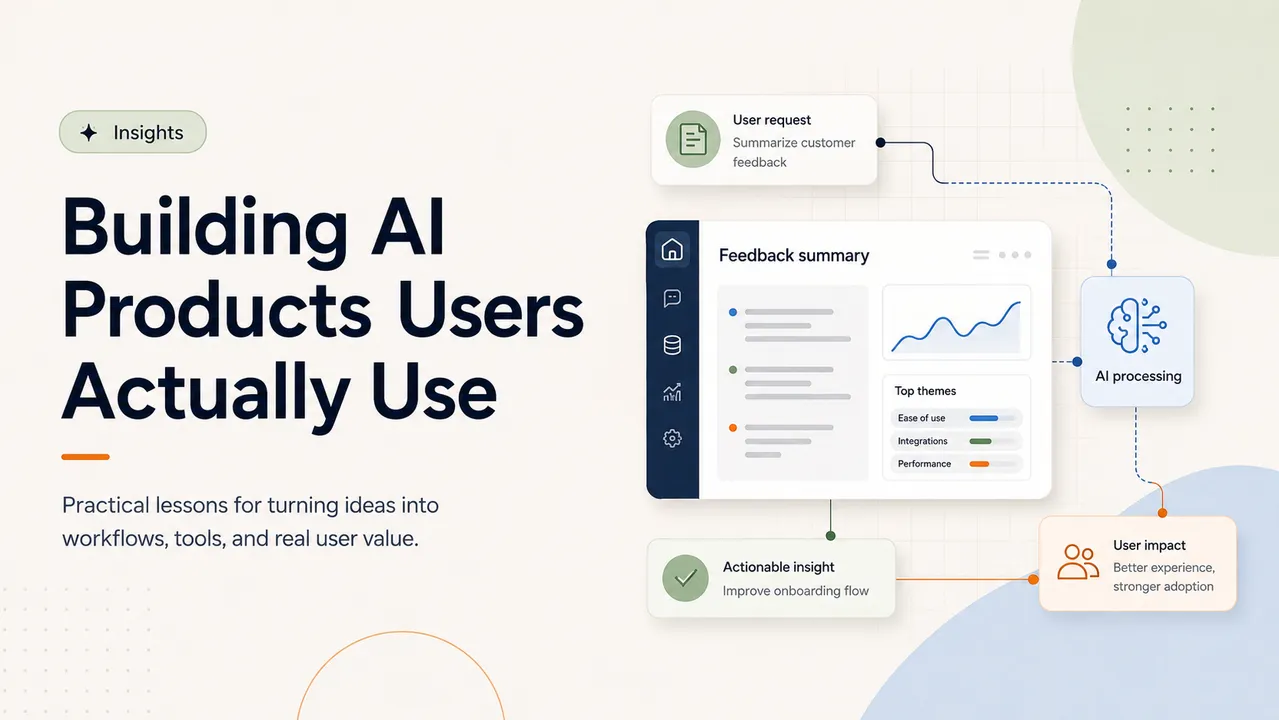
A raw paragraph from an AI model is rarely the final product experience. In most useful AI features, the output becomes a structured summary, a recommendation, a draft, a set of next actions, a tagged record, or a decision support card.
Design the output so users know what to do next. If AI summarizes feedback, let the team assign themes. If it writes listing copy, let sellers edit and publish. If it recommends matches, show why the result is relevant.
- Use structured response formats
- Show confidence or source context when helpful
- Let users edit, approve, save, or reject outputs
- Connect the result to product actions
Add fallback states and human review
Production AI features need a plan for uncertainty. The system should know what to do when the model has low context, a data source is unavailable, a response is incomplete, or a user asks for something outside the feature scope.
Fallback states do not make the product weaker. They make it trustworthy. Human review also matters for sensitive workflows such as healthcare, payments, marketplace moderation, compliance, or business-critical decisions.
Measure adoption, not just generation
Counting prompts or generated outputs is not enough. Track whether users keep using the feature, whether they accept outputs, whether they edit heavily, whether support volume drops, and whether the workflow is actually faster.
A good AI product improves over time through feedback loops. The team should be able to inspect usage, understand failure patterns, and adjust prompts, retrieval, UI, and data sources based on real behavior.
What to build first
Start with a narrow feature that has visible value and measurable usage. Good first builds include support summaries, listing assistants, document classification, internal search, review queues, or dashboard insights.
Avoid starting with a broad assistant that tries to do everything. A focused workflow is easier to test, easier to explain, and easier to improve.
Key takeaway
AI becomes useful when it is designed as product infrastructure, not a novelty layer. The model matters, but workflow design, context, safety, review, and feedback loops are what make users come back.
Related articles
Keep reading
AI + Sharetribe: Practical Automation for Marketplaces
Use AI to improve discovery, support, moderation, and operations in real marketplace workflows.
AI Features for Modern Marketplaces
From smart search to summaries and fraud signals, practical AI features that create real value.

Sharetribe Mobile Template: What to Build First
A practical roadmap for launching a mobile marketplace with the right flows, screens, and priorities.
Work With DevsCrew
Building a marketplace or AI product?
We help founders and teams design, build, and scale Sharetribe marketplaces, AI features, mobile apps, and complex product workflows.